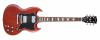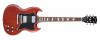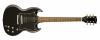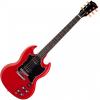


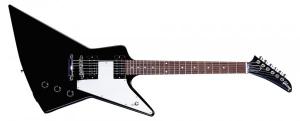
Gibson US Explorer Ebony 1968
Tip produs: gibson | chitara | chitara electricaProducator: Gibson
3% reducere pentru contactele prin clubafaceri.ro
Prezentare Gibson US Explorer Ebony 1968
DSXREBCH1
Explorer
With its angular, asymmetrical body and pointed headstock, the legendary Gibson Explorer was light years ahead of its time when it was first introduced in 1958. In fact, the Explorer was such a radical departure that Gibson produced only about 100 of the famed instruments—many of which are now highly prized collectibles selling for upwards of half a million dollars. Today, the same far-out, futuristic Gibson Explorer—reintroduced in the mid-1970s—is one of the most coveted powerhouses of screaming rock and roll.
The Explorer Neck Profile
No guitar neck profiles are more distinguishable than the neck profiles employed on the Gibson models of today. The more traditional ’50s neck profile is the thicker, more rounded contour, emulating the neck shapes of Gibson’s iconic models of the late 1950s. The ’60s neck profile is considered the more modern, slim-tapered contour most commonly associated with the Gibson models of the early 1960s. The neck on Gibson’s Explorer has the best of both worlds—it is a hybrid between the ’50s rounded contour and the ’60s slim-taper profile. As with all Gibson necks, it is machined in Gibson’s rough mill using wood shapers to make the initial cuts. Once the fingerboard gets glued on, the rest—including the final sanding—is done by hand. That means there are no two necks with the exact same dimensions. So while it still has the basic characteristics of its respective profile, each neck will be slightly different, with a distinct but traditional feel.
Solid Mahogany Body
The most central feature of any Explorer is its mahogany body, which provides players a well-balanced, weight-reduced guitar alternative, with absolutely no compromises in tone, sustain, or performance. The Explorer’s body is a solid piece of mahogany in the classic style of the 1976 Explorer. The mahogany goes through the same rigorous selection process as all of Gibson’s woods, and is personally inspected and qualified by Gibson’s team of skilled wood experts before it enters the factories. Inside the Gibson factories, humidity is maintained at 45 percent, and the temperature at 70 degrees. This ensures all woods are dried to a level of “equilibrium,” where the moisture content does not change during the manufacturing process. This guarantees tight-fitting joints and no expansion, and controls the shrinkage and warping of the woods, in addition to reducing the weight. It also improves the woods’ machinability and finishing properties. Consistent moisture content means that a Gibson guitar will respond evenly to temperature and humidity changes long after it leaves the factory.
Gibson’s 496R and 500T Pickups
No event is more responsible for dramatically influencing the evolution of popular music than Gibson’s introduction of the double-coil “humbucking” pickup in 1955. From the warm jazz tones of Charlie Christian, to the world-shaking rockabilly of Scotty Moore, and the cruching rock of Jimmy Page, countless players around the world explored the limitless possibilities of the tonal spectrum through Gibson pickups and guitars. As the musical landscape changed, so did the development of the humbucker pickup. Introduced in the early 1970s, Gibson’s 496R and 500T pickups filled the need for more powerful humbuckers and energized the emergence of hard rock and heavy metal. The 496R produces incredible sustain and cutting power with its ceramic magnet, adding more highs with increased definition and no muddiness at all. The 500T is one of Gibson’s most powerful pickups, containing a three ceramic magnet structure, which enables a no-holds-barred rock and roll crunch that never loses its rich combination of enhanced lows and crystal clear highs. This is one of Gibson’s most potent pickup combinations.
Angled Headstock
The angled headstock is another example of Gibson’s industry-changing way of thinking. Every Gibson headstock is carved out of the same piece of mahogany as the neck then fitted with Gibson’s traditional wing blocks. It is not a “glued-on” headstock, and the process takes craftsmanship, time, and effort. But the rewards are worth the effort. The headstock is carefully angled at 17 degrees, which increases pressure on the strings and helps them stay in the nut slots. An increase in string pressure also means there is no loss of string vibration between the nut and the tuners, which equals better sustain.
Body
Body Style
Explorer
Body Species
Mahogany
Hardware
Plating Finish
Chrome
Tailpiece
Gibson Stop Bar
Bridge
Gibson Tune-O-Matic
Tuners
Mini Grovers
Electronics
Neck Pickup
496R
Bridge Pickup
500T
Pickup Covers
No
Controls
2 Volume - 1 Tone - 3-Way Toggle
Control Knobs
Black Speed
Control Pocket Cover
Black Plastic
Neck
Species
Mahogany
Nut
Corian
Nut Width
Standard Gibson: 1.695" +/- .050"
Headstock Inlay
Gibson Logo
Truss Rod
Gibson Adjustable Truss Rod
Truss Rod Cover
Bell-shaped cover
Fingerboard
Fingerboard Species
North American Rosewood
Inlays
Acrylic dot
Number of Frets
22
Scale Length
24 - 3/4"
Case
Type
Gibson Hardshell
Case Interior
White
Case Exterior
Black
Silkscreen
Gibson USA Logo
S********************
va rugam sa va autentificati accesand urmatorul buton:
PRODUSE ASEMANATOARE CU GIBSON US EXPLORER EBONY 1968